
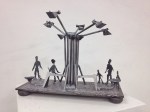
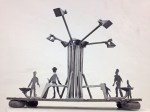
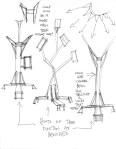
In summer 2016, I received Myers Foundation research funding from the WVU School of Art and Design to create the Character Generator series, my first body of work made entirely with 3D scanning and 3D printing processes. I began this series by scanning small temporary studies made from clay, metal, wood, and other found objects, a process which unified each of these disparate constructions into a cohesive whole. This aspect of the process was quite liberating, as it allowed me to work in a direct, improvisational manner, much like creating a digital collage. My preconceived notion of 3D scanning was that it would be just like making a mold to reproduce an exact replica of an object. However, I found this process was more akin to taking a fleeting, snapshot impression of an object, and I fully embraced the distortions and digital chatter inherent to these technologies.
In fall 2016, I had the pleasure of discussing this research project at the annual Southeast College Art Conference (SECAC) in Roanoke, Virginia. My presentation, entitled Fragments of Signifiers: 3D Printing & Scanning As Digital Collage, was part of the panel discussion No Hands?: Digital Fabrication and Craftsmanship chaired by artist McArthur Freeman, with fellow artist panelists Kelly O’Briant and Ryan Buyssens. All in all, I think The Character Generator series marks a significant and very exciting step in my artistic growth. The process of assembling these sculptures imbues the Character Generator series with appealing qualities of memory, humor, and cryptic beauty, and I have no doubt this research will lead to more ambitious art making endeavors using new technologies.
-
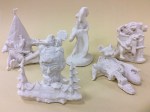
- Character Generator #1-5
-
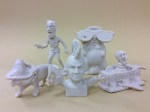
- Character Generator #6-10
-
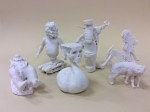
- Character Generator #11-15
-
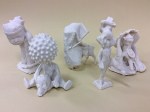
- Character Generator #16-20
-

- Found object sculpture & finished 3D print
-

- Found object sculpture & finished 3D print
-
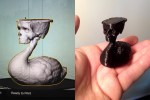
- 3D model screenshot & finished print
-
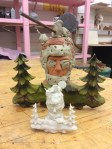
- Found object sculpture & finished 3D print
-

- Sculpture assistant modeling clay on found object sculpture
-

- 3D scanning found object sculpture
-

- 3D scanning found object sculpture
-

- 3D scanning found object sculptures
-

- 3D scanning found object sculpture
-

- Found object sculpture & 3D model screenshot
-
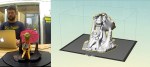
- Found object sculpture & 3D model screenshot
-

- 3D scanning found object sculpture
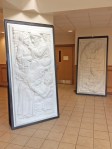












 Dylan Ethan Collins